Lost in Transcription
From raw audio to real-world use in a low-resource language
Marija Stojcheva, MSc & Hristijan Gajdov at PyData
VEZILKA, FINKI / UKIM, EuroHPC JU, Grant No. 101263128

One lecture clip, four transcripts
A held-out FINKI lecture clip (11 s). Press play, then compare the four transcripts.
Where we are going
Why Macedonian is hard
What makes a language “low-resource” for speech recognition?
Low-resource is about labels, not speakers
One recording, two correct transcripts
Ohrid regional speech (SYNDI), 6 s. Same audio, two layers in vezilka-ai/macedonian-speech.
Off the shelf, dialects break everything
How modern ASR works
Two architectures, one way of scoring them
Whisper: an encoder that listens, a decoder that writes
Moonshine: built for short clips on small devices
How we score: word error rate
The data
Where 3,456 hours of Macedonian speech came from, and what we did to it
vezilka-ai/macedonian-speech
From long recordings to training pairs
Doniraj: a platform for donating your voice
Preprocessing: small rules, big consequences
A benchmark humans listened to, clip by clip
Our models
Adapt a big model cheaply, then teach small ones with it
Our open models on Hugging Face
Approach A: LoRA on Whisper
Approach B: a teacher labels, small students learn
Engineering: 3 million clips, zero local copies
Results on the FINKI lecture benchmark
Hear it for yourself
Three held-out benchmark clips. Pick a tab, press play, then read what each system heard.
Accuracy, size, speed: pick two
What still breaks
Beyond transcription
Dialects, who spoke when, and asking questions of hours of audio
From Marija's master's thesis: “Toward Unified Speech Recognition and Understanding in Low-Resource and Dialect-Rich Languages”.
LoRA closes most of the dialect gap
Who spoke when: diarization across sessions
Ask the recordings: graph-based RAG
Дојава · Dojava
A voice fault line: a call comes in, a field team goes out
From a voice message to a dispatched team
A caller to the electricity or district-heating fault line hears: “After the tone, say your name, describe the problem, then your address and town.” Dojava does the rest.
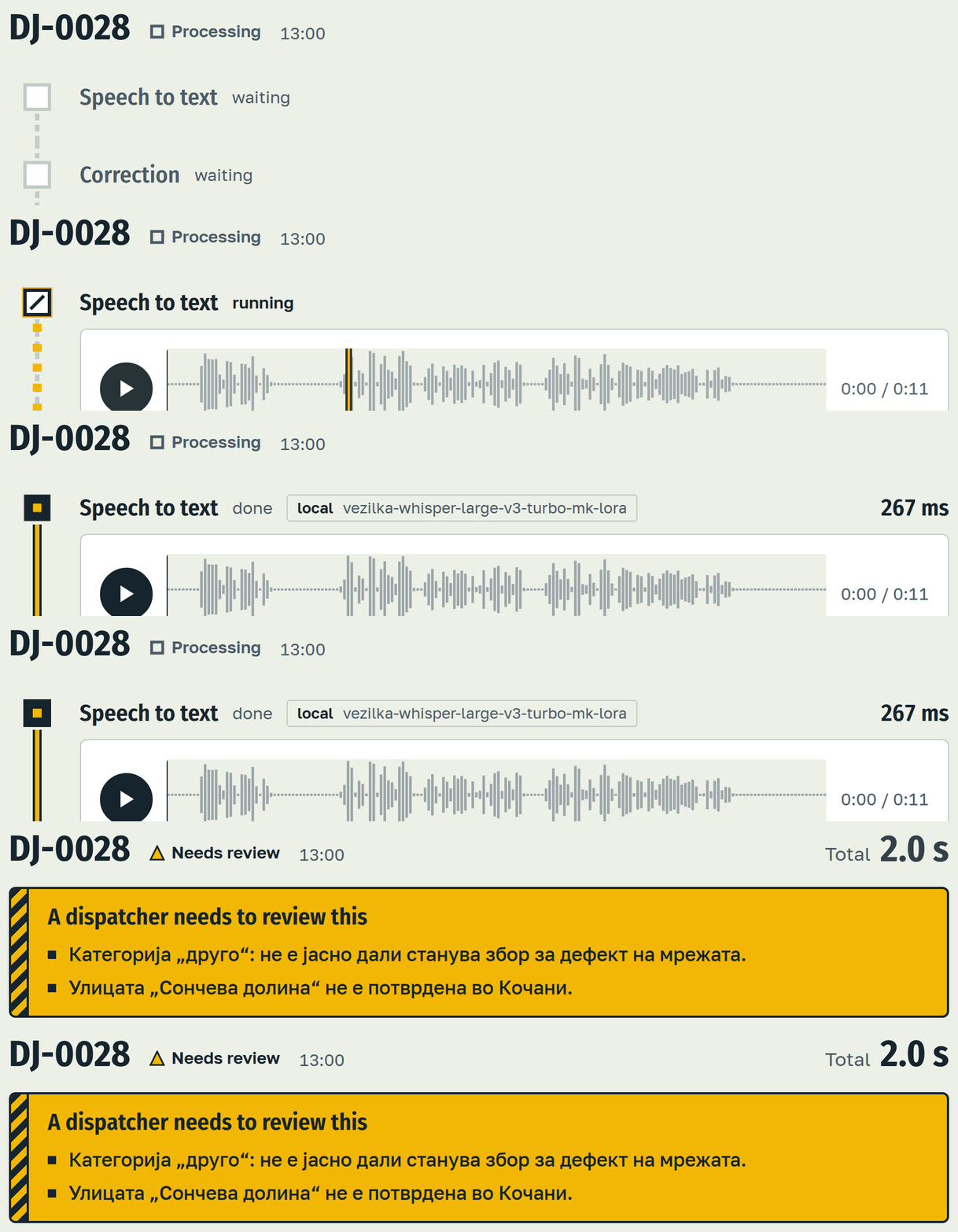
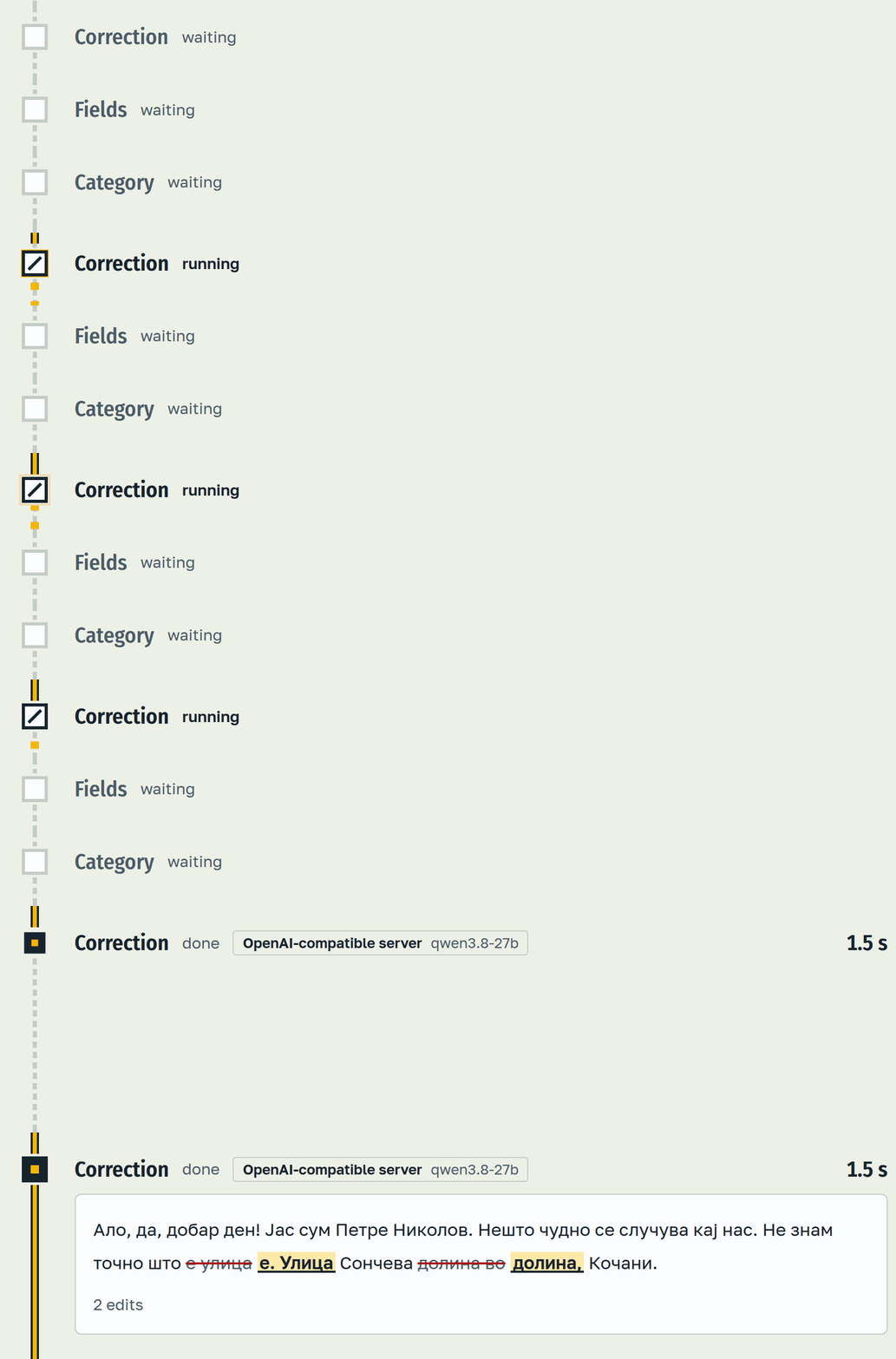
A call, live: every stage streams in
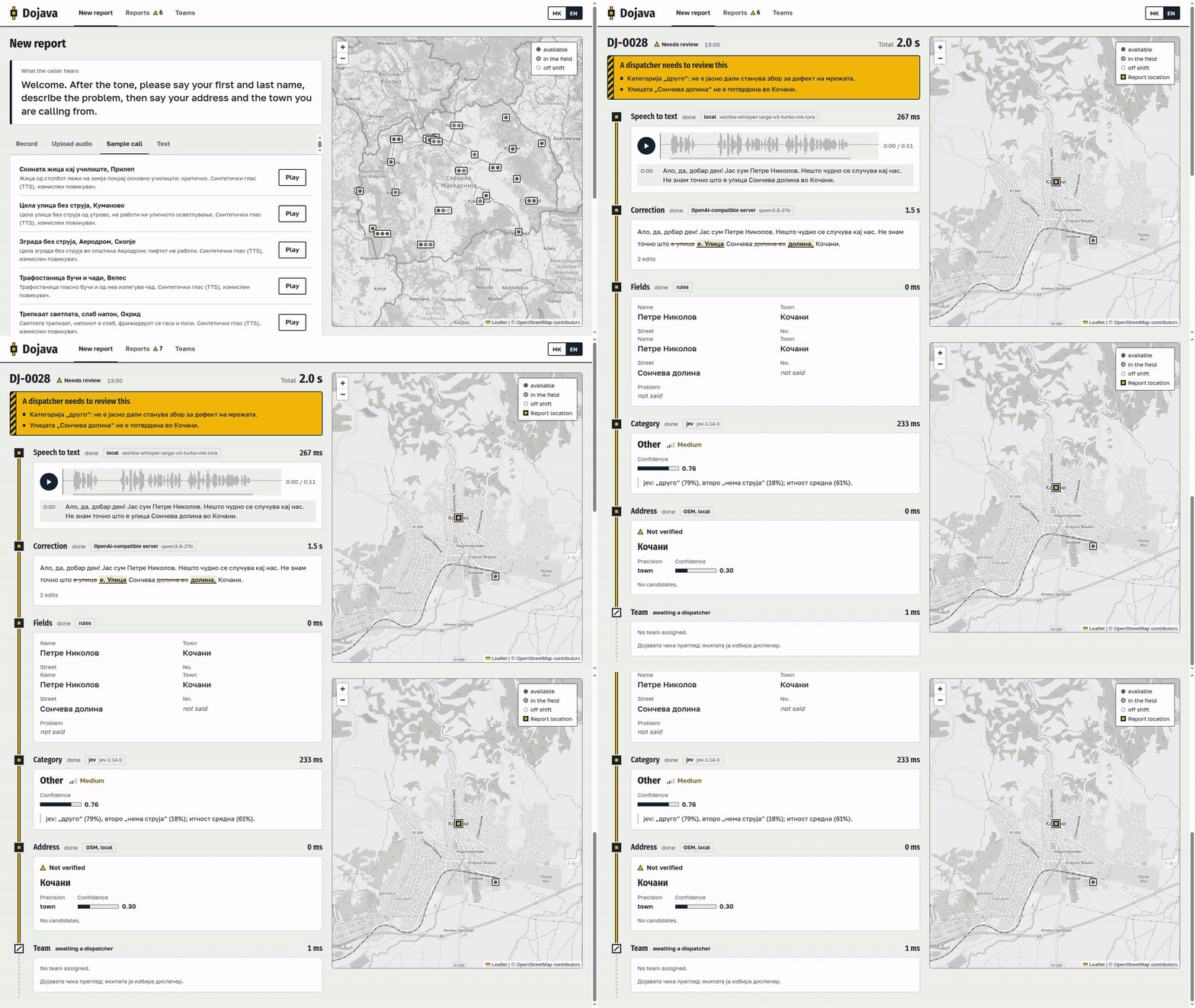
- Speech to text lands first: waveform, timestamped segments, 267 ms.
- Correction shows its edits as a diff.
- Category “Other”, confidence 0.76.
- Address “Сончева долина” is not in OpenStreetMap for Kochani.
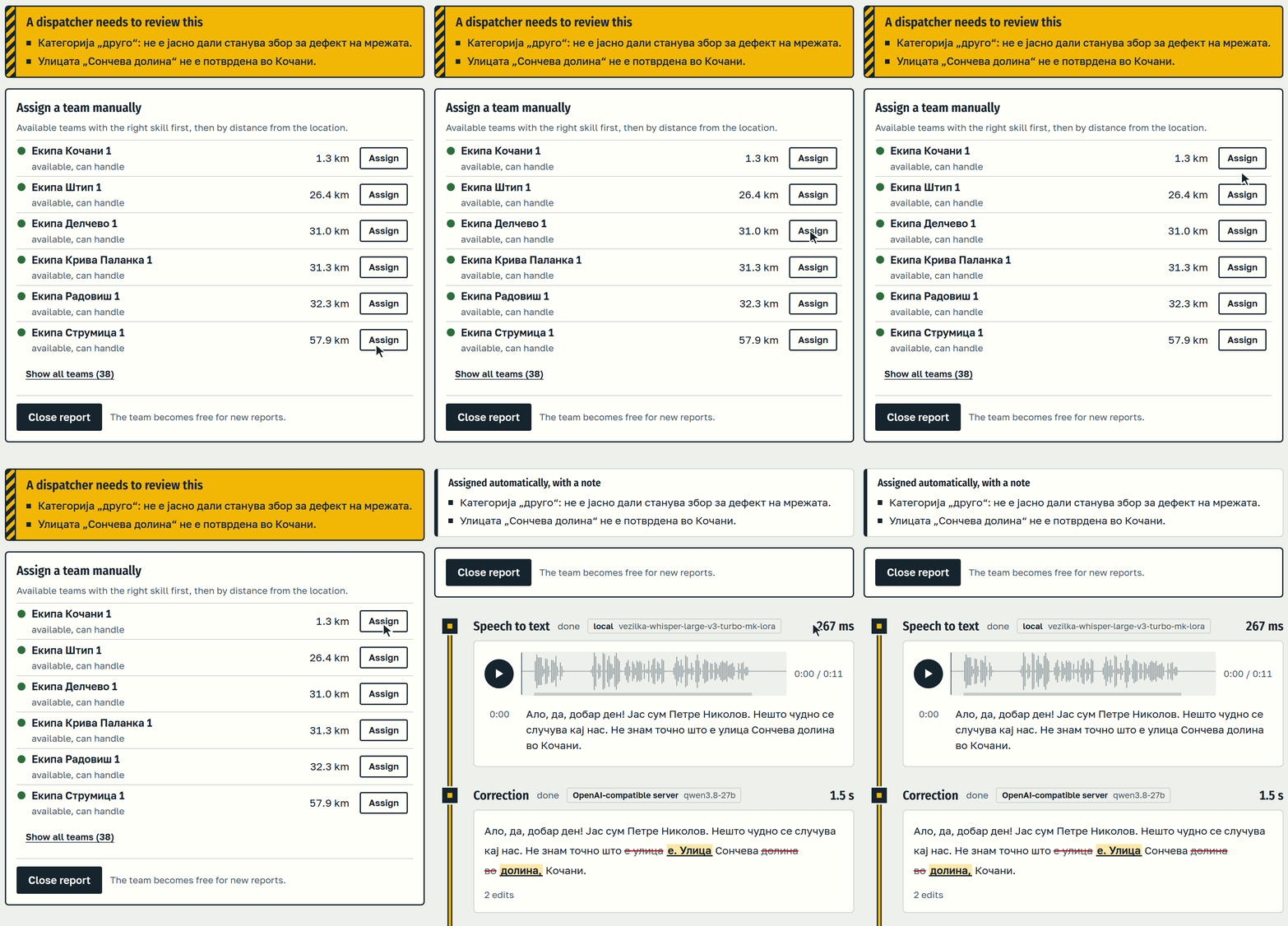
- So the ticket goes to a dispatcher, with the reasons on top.
Recorded from the running console: the “unclear report, unknown street, Kochani” sample call, 2.0 s end to end.
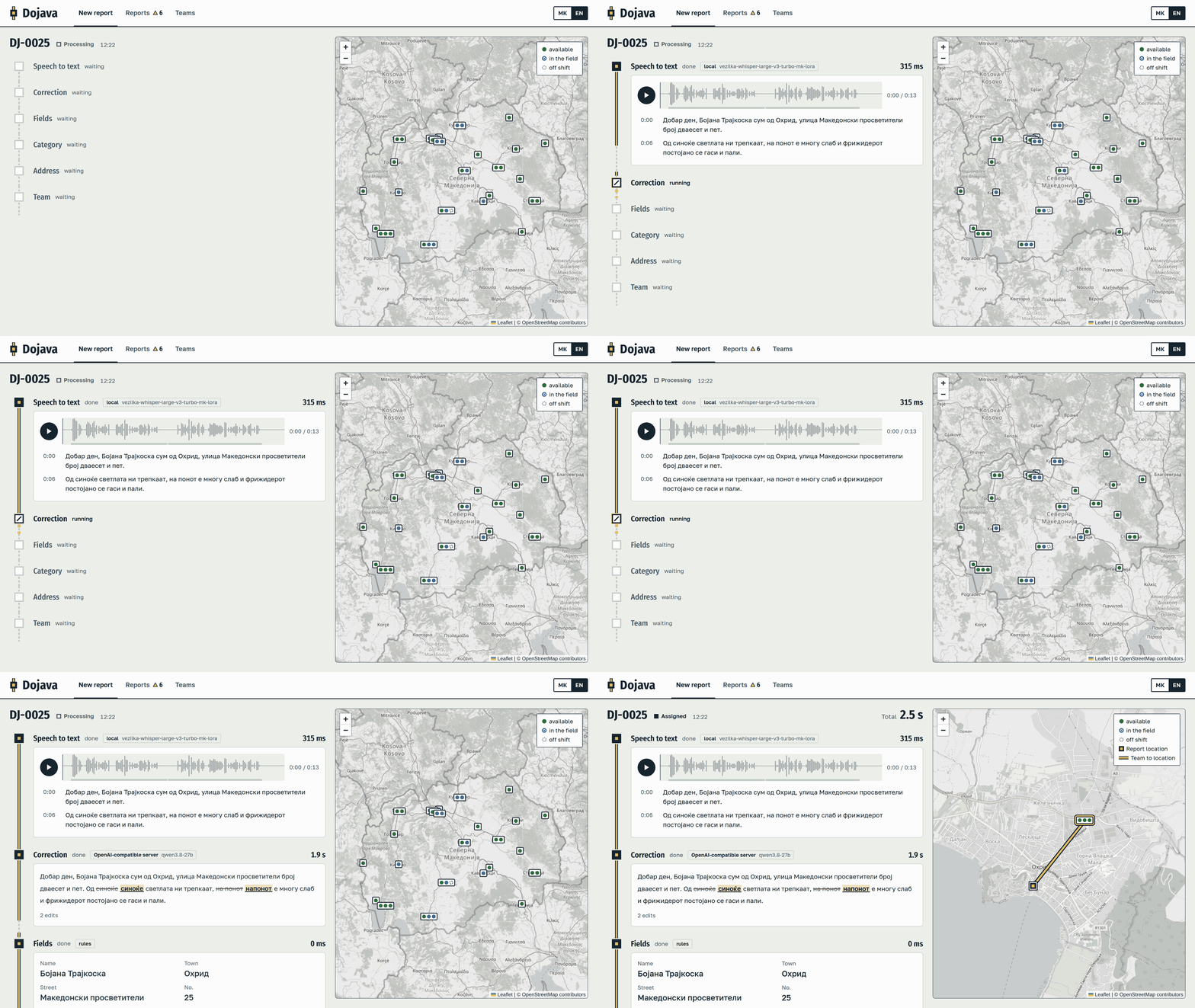
Confident call, part 1: hear it, understand it
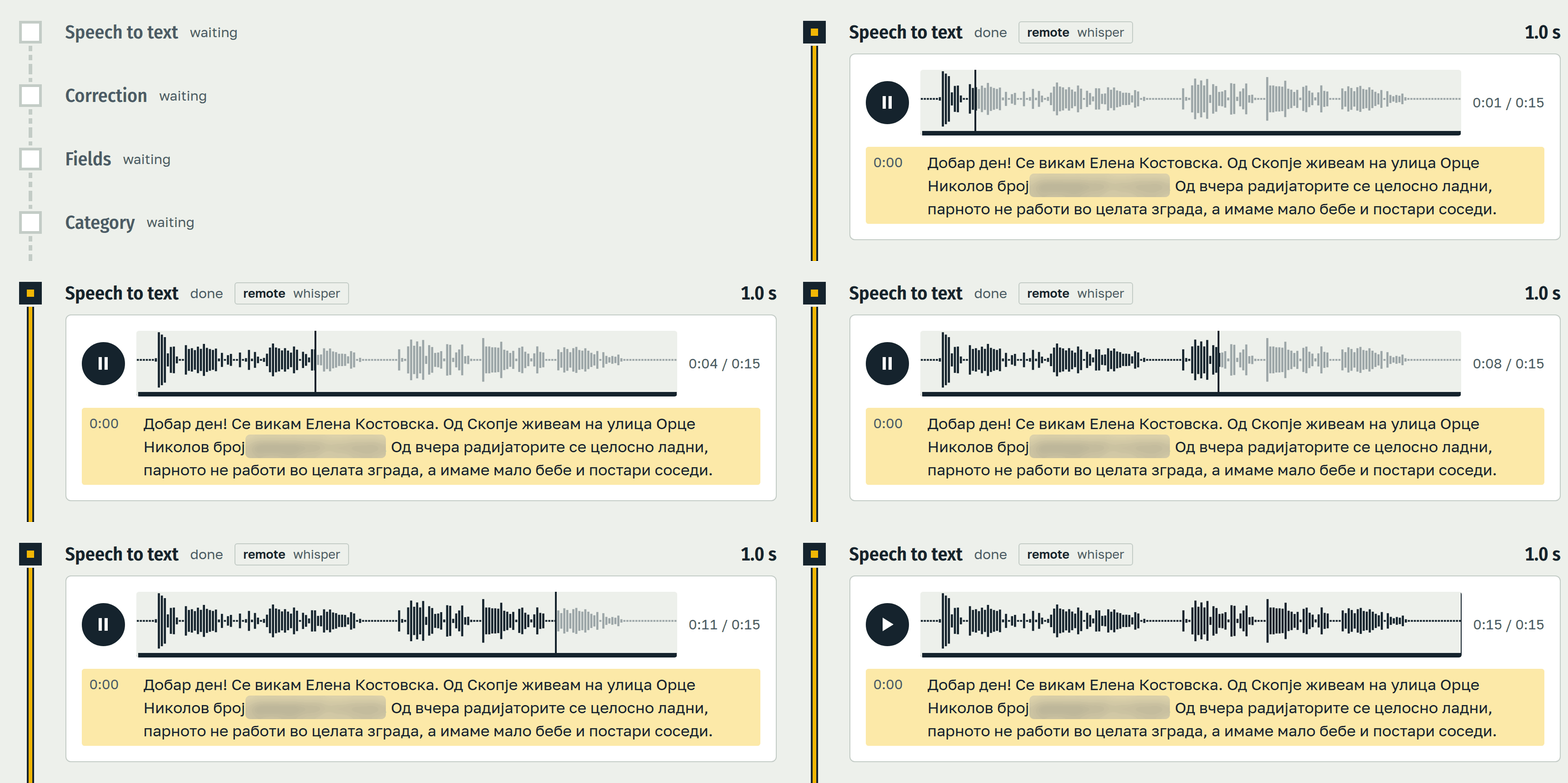
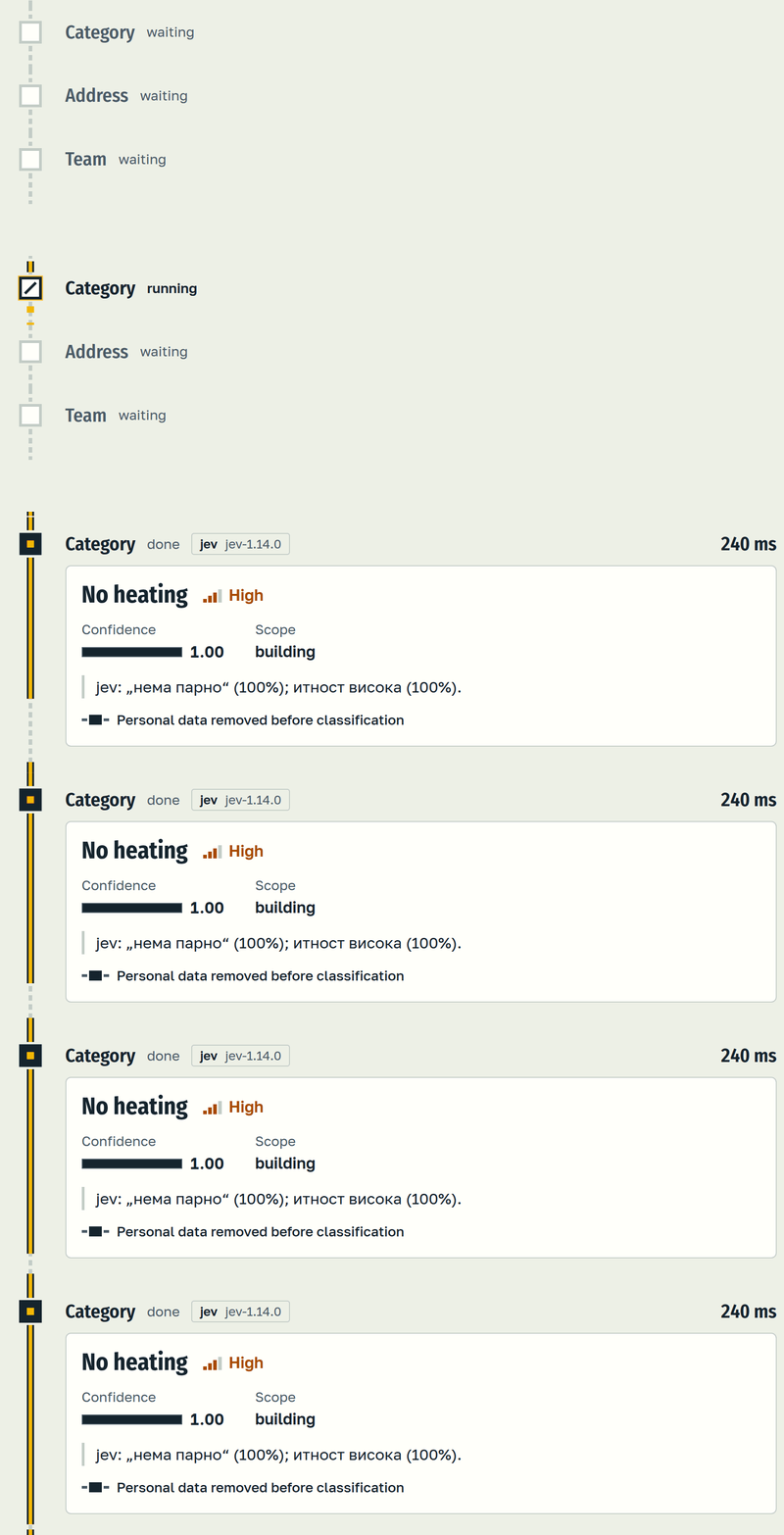
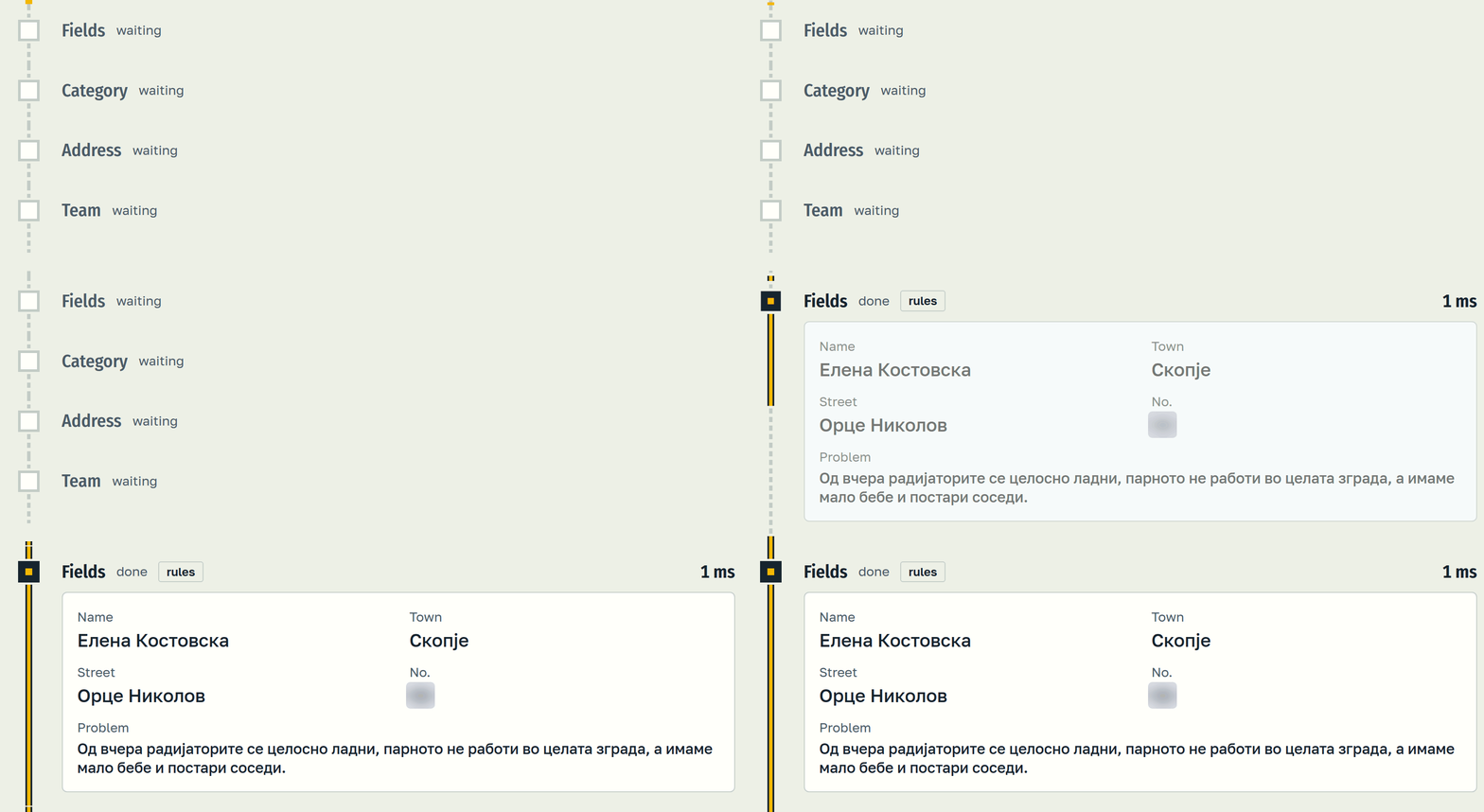
The LLM corrector made no edits: the transcript was already right. Personal data was masked first: the classifier saw [ИМЕ], not the caller's name.
Confident call, part 2: find it, send a crew


Unsure call: a human decides
The whole flow in one view
- New report: play a sample call, upload audio or record one; the stages stream in live.
- Map: the report location and the assigned crew's route to it.
- Reports: the queue; “Needs review” tickets wait for a dispatcher.
- Teams: who is free, who is in the field, and where.
What we learned
Limits and next steps
Honest limits
- The benchmark is 5 lectures and 4 speakers: one domain, no confidence intervals
- WER punishes valid dialect spellings; orthography and recognition errors mix
- Macedonian dialect corpora are small and narrow, so dialect WERs may not carry over to other speakers and settings
- Diarization was assessed qualitatively; RAG judges are weak in Macedonian
Next
- More dialect speech: regions we barely cover (Tikvesh: 97 clips) and regions we have no recordings of yet
- A gold-standard benchmark for ASR, diarization and RAG beyond lectures
- Semi-supervised training on unlabelled recordings
Use it, and donate your voice
huggingface.co/vezilka-ai
- vezilka-whisper-large-v3-turbo-mk-lora
- vezilka-moonshine-base-mk
- vezilka-moonshine-tiny-mk-lr2e-4
- vezilka-moonshine-tiny-mk-lr5e-4
- datasets/macedonian-speech
Every dialect clip we have is a few hundred voices. Read a few sentences in yours: it takes five minutes and directly improves the next model.


Thank you · Ви благодариме
Teaching Macedonian AI takes data and care. Questions?
Supported by the Ministry of Education and Science of North Macedonia (“Utilizing AI and National Large Language Models to Advance Macedonian Language Capabilities”) and co-funded by EC/EuroHPC JU, the Ministry of Digital Transformation and FINKI through the VEZILKA project, Grant Agreement No. 101263128. Regional recordings: SYNDI project, Ministry of Culture (2021). Contact: info@vezilka.ai